Having left the financial field almost a decade ago for a chemical world of lubricants and heavy engineering, I have always been fascinated to monitor and analyse oil market trends through the prism of my financial knowledge, putting it into perspective for myself, our company and anyone who could find it interesting.
As always, the latest madness on the global base oil market, where prices on basic grades of oils practically doubled in a short period, sparked my interest. And the pricing phenomenon of Hydraulic Oil, the most used lubricant in the world, would be the most interesting example.
The situation is paradoxical. While the standard market offering of a drum of Hydraulic HM-68 ranges between R23.50 and R27.00 per litre in a 208-210L drum, we saw the very same grade being offered at the R17.50-R19.00 pricing range. Taking into consideration the current dollar exchange rate and prices of base oils, DIRECTLY from European traders, the R17.50 offer to market appeared to be sold 10-15% below the cost of the base oil mix. And that is before the cost of an additive package and a drum. Yet, the market is reassured that the offered hydraulic oil is made of virgin base oils and meets all specifications. So, something in this equation did not make any business sense, as the numbers had just not added up.
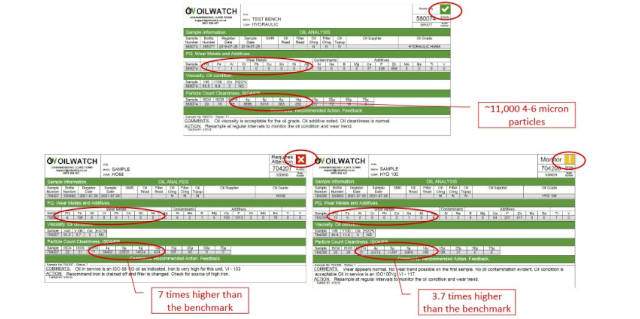
So, to understand how such an offer is made possible, we obtained two samples from different suppliers and submitted them to an independent laboratory for chemical testing. The samples were bought as new (unused) hydraulic oil. The results are illustrated on the slide. The top sample is a standard HM-68, which is fully compliant with DIN 51524 part 2 (21/19/16) and has been used as a benchmark. The other two (bottom left and right), are the samples of purchased samples.
As can be seen on the slide, both samples are heavily contaminated with 4–6-micron particles, exceeding benchmarked levels by 3,7 (on the right) to 7 times (on the left). The presence of iron in the first sample (on the left) is 136 times higher than in the benchmarked sample and was flagged by the lab as non-compliant with a recommendation to replace the oil, or at least send the oil for filtration and replace a filter in the hydraulic system. In other words, if you continue using this hydraulic, there is a high chance of system blockage and equipment failure.
The second sample (on the right) showed excessive contamination by the metals, exceeding the benchmark 7 times. The oil was put as a “watch out” grade by the lab, i.e., it would require continuous monitoring and would require to be replaced shortly to prevent equipment deterioration.
Such levels of particle/metal contamination highly suggest at least partial use of either refined base oil or used oil in production. The quality of refined oil and the mixing ratio between virgin and refined/used oils will result in a higher or lower level of contamination.
So, as a very vague example, let’s consider a simple blending comparison. The current price for base oil mix (SN150 and SN500) for HM-68 will get you between R17.00 and R18.50 per litre, additives will contribute another R1.50 to R2.00. Add packaging, labour, and manufacturing and re-sellers margins and that will bring you to the abovementioned price range of R23.50 to R27.00. But if you add refined oil, which you can currently source for between R6.00 and R10.00 per litre at a 50/50 mix, your averaged base oil cost drop to ~R12.87 [(R17.75+R8.00)/2], delivering the desired R5.00-R7.00 reduction in the price of hydraulic. Now the numbers started to make sense, and the decision of quality vs. price is left entirely up to the user/buyer of hydraulic oil. But you should not be under the illusion that when buying hydraulic HM-68 for under R20.00, you are not buying a quality product, so get it sampled and individually tested before making your final decision. At the end of the day, one must always consider maintenance intervals, component wear and replacement cost, and machine life vs. “savings” on low-cost hydraulic oil. In other words, low-cost hydraulic oils may appear to offer cost-saving potential, but in reality, will increase the overall maintenance cost of the hydraulic system.
Lastly, in very simple terms and without going into the very specific hydraulic application, (i.e. zinc free, ash-free, synthetic hydraulics, etc.) I wanted to disclose some rough pricing guidelines for various hydraulic ranges:
- HM range with the use of refined oils – R17.5 – early R20s
- HM range with virgin oils, for standard applications with basic anti-wear qualities and Viscosity Index (VI) at 105-115 – R23.50-R27.00
- HVI range is designed for high-pressure applications and has advanced anti-wear qualities with VI at 130-145. This product will cost you R2.00 to R4.00 more than the HM range (depending on the brand).
Please click the link on the original Engineering News article.